The Denali Community’s Top 5 Responses to Trump Administration Actions
By Erica Watson. Photo by Eve Baker/Fairbanks Daily News-Miner
In February, DCC shared the top five trump administration actions likely to impact the Denali community. Since then, listing five things has started to feel like something of a joke, given DOGE’s demand that federal employees waste time every week emailing a list of five things they’ve done to an email address managed by AI programs and a handful of wealthy teenagers. Still, we figured we’d stick with the format, and share five ways that Denali Citizens Council and the Denali community have been working to protect the land and people we love from the administration’s harmful agenda.
- Supporting community members impacted by illegal firings, hiring freezes, and destabilization of the National Park Service:
Hiring and spending freezes hit Denali National Park almost immediately, and just as quickly, the community jumped into action.
Two weeks after Inauguration Day, about 15 community members gathered at the Murie Science and Learning Center in solidarity with park staff, and in recognition that destabilizing the National Park Service will have rippling impacts on our local and statewide economies. The February 5 gathering offered community members a chance to share concerns, best practices for calling our elected representatives, fears for our individual and collective economic futures (and cookies).
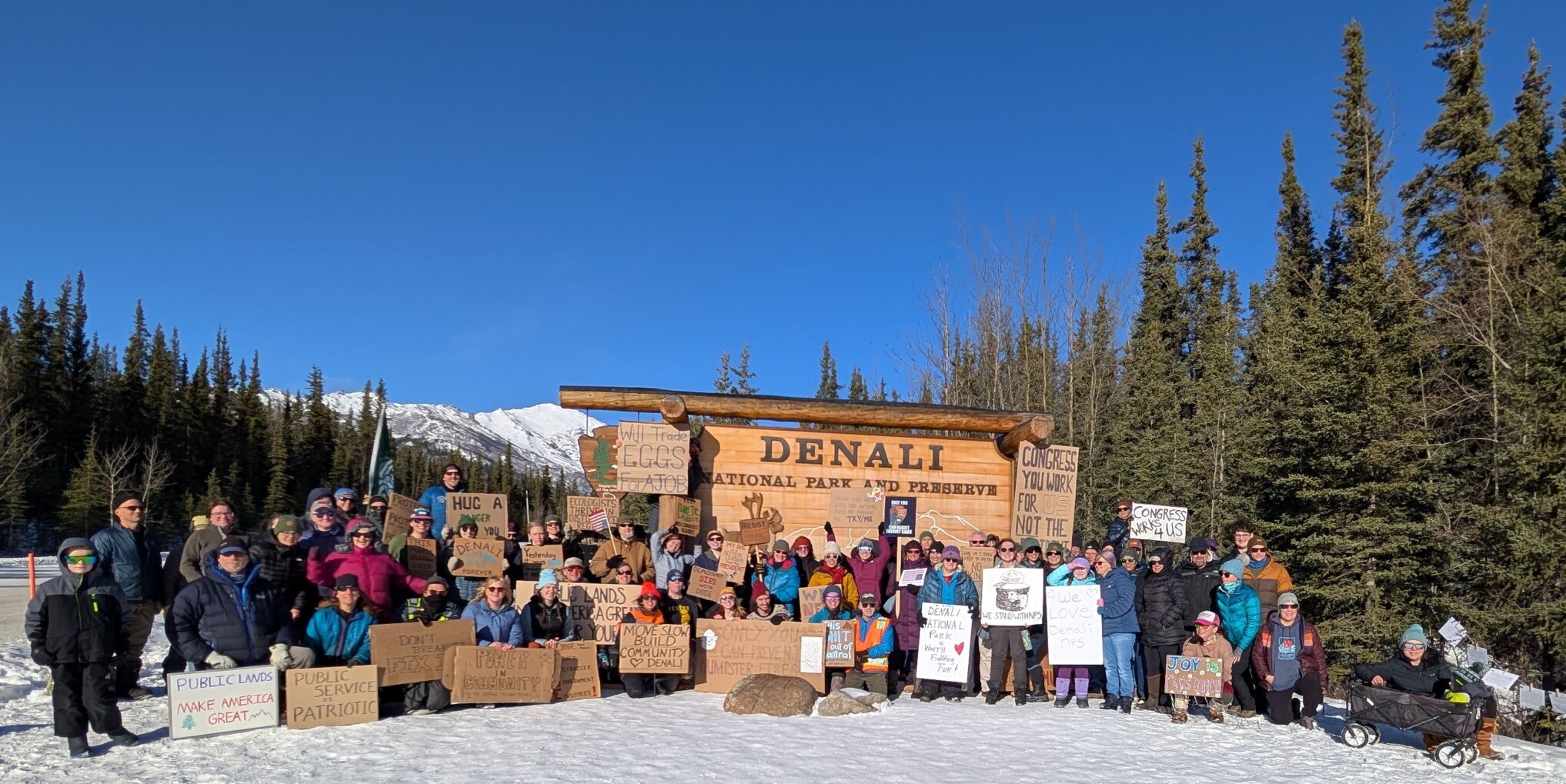
On March 1, the Denali community joined the nationwide day of protest against firings and funding cuts to the National Park Service, and many of us were surprised and encouraged by the turnout: 90 people gathered at the Denali entrance sign, and after sharing words of encouragement, support, and solidarity, walked to the highway intersection. Passersby honked and waved, and in spite of the circumstances, many of us carried the affirming energy of that day forward as we made calls to elected leaders, supported family and friends navigating sudden uncertainties in their careers, and planned for what might come next.
Prior to the court order requiring reinstatement of fired probationary employees, some impacted Denali employees spoke to the media about their work. In a March 5 interview, Jodi Rodwell, executive director of the Denali Education Center, and Hannah Ragland, education program manager at Denali who was fired and has since been reinstated, spoke about how each NPS position lost (even temporarily) has rippling impacts on multiple programs. “Each one of us has our own skill set that they brought to the park, helping it run safely and efficiently,” Hannah said.
Though the legal landscape remains messy, those fired at Denali are now back at work. Seasonal hiring was delayed, but has continued, though many permanent positions remain vacant. Community members impacted by firings at other federal agencies remain engaged with legal and administrative appeal processes. DCC remains supportive of these community-led actions.
- Tracking changes to NEPA and other environmental law:
In a move consistent with the administration’s attacks on environmental regulations, changes to how the National Environmental Policy Act, or NEPA, will be implemented were announced in March.
Trustees for Alaska, the Anchorage-based law firm that takes on much of the environmental law work in the state, shared helpful background on what NEPA does, and why it’s important, here. A couple key points:
NEPA requires the federal government to assess the environmental impact of major projects requiring a final agency action (e.g., a permit) before making decisions or taking actions on them. It further establishes a broad national framework for accomplishing that goal. It’s common sense, really, to consider the consequences before doing something.
In other words, environmental impact statements and assessments provide consistent systems for allowing local communities, scientists, stakeholders and the public to express concerns on the record and assess whether those concerns were addressed in the decisions agencies make.
Denali Citizens Council, alongside hundreds of environmental and conservation organizations and individuals around the country, submitted comments to the Council on Environmental Quality (CEQ) on these changes. DCC’s letter states:
“[W]e argue that the change proposed in this rule will likely promote error and inefficiency as each agency tries to develop its own regulations, that the change is unnecessary, that it is duplicative, is costly, and will result in unnecessary litigation. No cogent explanation for why such a change is considered appropriate was made in this interim rulemaking.“
For more information on what these changes could mean, check out this article from the Audubon Society. We are part of a national community of advocacy organizations tracking what these changes will mean, and will continue to take action at every opportunity.
- Engaging with the Alaska delegation on how the administration’s actions are affecting Alaskans
In DCC’s March 21 letter to Senator Murkowski (also shared with Senator Sullivan and Representative Begich), we stated:
“The Denali Borough has the highest levels of federal employment in Alaska, per capita, but these losses are not just numbers— they are friends and neighbors, civil servants who have dedicated their lives to protecting our public spaces and natural resources. While we, as a community, have limited tools to forecast what the full impact will be, we are already feeling the effects; and our experience here may well be emblematic of what’s to come in the rest of the state, and around the country.“
Senator Murkowski has demonstrated that she’s able to listen to her constituents and navigate politically complex situations, and DCC and the Denali community will continue to urge her leadership on matters of federal funding, dissolution of government services, and attacks on constitutionally protected freedoms. Community members impacted by illegal firings reported productive conversations with Senator Murkowski’s staff as they navigated their next steps. As we noted in our letter, and as Denali Borough Mayor Chris Noel noted to the media in February, in a small community, we may not always know the extent of each dollar lost or unfilled until those changes are well underway, and as Mayor Noel said, “We’re all in it together.” We need elected officials who work with us for solutions, and will continue to push them to do so.

- Honoring Indigenous stewardship and naming traditions
Immediately following the president’s Day One Executive Order renaming the mountain to its previously used colonial name, it became clear that the change wouldn’t fly locally. The name “Denali” has deep meaning and history, and for many non-Native people who care deeply about this place, represents an invitation to gain a deeper understanding of Indigenous relationships to the land. Ahtna elder Wilson Justin said in response to the name change that it may be hard for the president to understand the depth of that relationship, but it won’t change how he thinks of the mountain. “You didn’t want to refer to those places in kind of a low way, a dismissive way,” Justin said.
In a January 22 Facebook post, the Denali Borough weighed in: “We’ll continue to honor the mountain with the name gleaned from its very peaks and ridges and borne from the wonder it gifts to all who are lucky enough to catch a glimpse.”
In recent years, the National Park Service has made an effort to honor less well known original names as well, by including them on signs and websites, and offering pronunciation guides for Native place names. These inclusions have inspired curiosity and gratitude from locals and visitors, who will undoubtedly remain interested in Denali’s history, regardless of petty executive orders. We’re sure to keep seeing “Denali Forever” stickers and buttons around Alaska (thanks, Talkeetna Historical Society) and to find ways to share real stories of this remarkable place with visitors.

- Monitoring proposed Alaska industrial mega-projects–and their impacts on Denali
While much of the administration’s executive order on Alaska reads like a predictable wish list of extraction projects, some of its agenda items are more likely to have local impacts than others if implemented.
Among those, the long-proposed and long-stagnant Alaska LNG pipeline has been in the news recently, as the executive order gives Governor Dunleavy and other climate-denying politicians new drive to find funding for the project. Many of us are used to hearing every few years that the pipeline is “closer than ever,” only for the announcement to cycle out of earshot for another three to thirty years, so it’s easy to ignore this round of enthusiasm too. The proposed route through Denali Borough and park was never finalized, and remains one of the cited challenges to the always-imminent but unfunded construction. In order to move forward, local government, agencies, and property owners must be involved. A recent report by several Alaska conservation organizations concluded that “No version of the project is economically feasible.”
And as economist Roger Marks wrote in an op-ed last week, “The fate of the Alaska LNG project will depend not on the merits of the enterprise, but on how much strong-arming can be applied. As we saw last week, that is not much.”
Still, given the proposed route through Denali National Park and local communities, the unacceptable climate impacts of large scale LNG export, and the recklessness demonstrated by this administration, it’s important to keep our eyes on any developments.
For more on the conservation community’s response to key elements of the Alaska executive order, visit Trustees for Alaska’s summary here.
These have been busy, disorienting months, and we’d love to hear from you: What have you been doing in recent months to push back against the administration’s agenda?